
LESSON 4 · Black Holes: Where Physics Breaks
What You Would See
As you approached a black hole, light from the universe behind it would bend around the event horizon, creating an Einstein ring — a halo of distorted starlight. The sky above you would compress into a shrinking circle of redshifted light, dimmed and stretched toward the red as you fell. Below, only darkness. Every photon from the universe gets funneled into that overhead window.
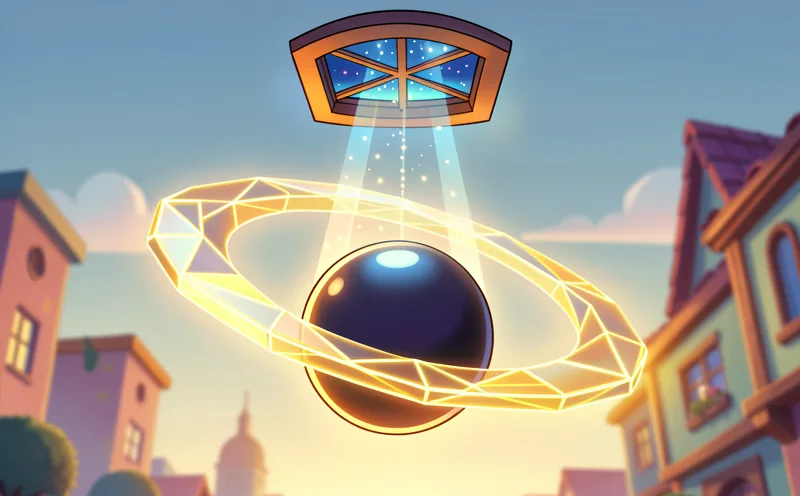
Falling through the event horizon, you would not see a boundary. The dark region simply grows until it fills your entire lower hemisphere. Looking back at the universe, you would see the outside sky squeezed into a small, redshifted spot overhead — and because you reach the singularity in a finite stretch of your own time, only a finite slice of cosmic history would ever reach your eyes. You would not witness the universe's entire future, despite a popular myth that says otherwise.